Clear Aligner Invisalign Treatment for Adults: The Way to Move Beyond Braces
When orthodontic treatment is mentioned, metal braces are often the first thing that comes to mind for many people. However, today, dental crowding, gaps between teeth, and certain bite problems do not have to be treated only with traditional braces. Especially for adults with aesthetic concerns, Invisalign clear aligner treatment is a more aesthetic orthodontic option that helps align the teeth more properly.
Invisalign treatment for adults allows the teeth to move gradually through custom-made clear aligners. Since the aligners are transparent and removable, the treatment becomes easier to integrate into daily life.
Free Information Form
Get Detailed Information!
What Is Invisalign (Clear Aligner)?
Invisalign is an orthodontic treatment method that helps straighten teeth without wires, using custom-made clear aligners. In this treatment, instead of metal brackets and wires, removable aligners designed to fit the teeth are used.
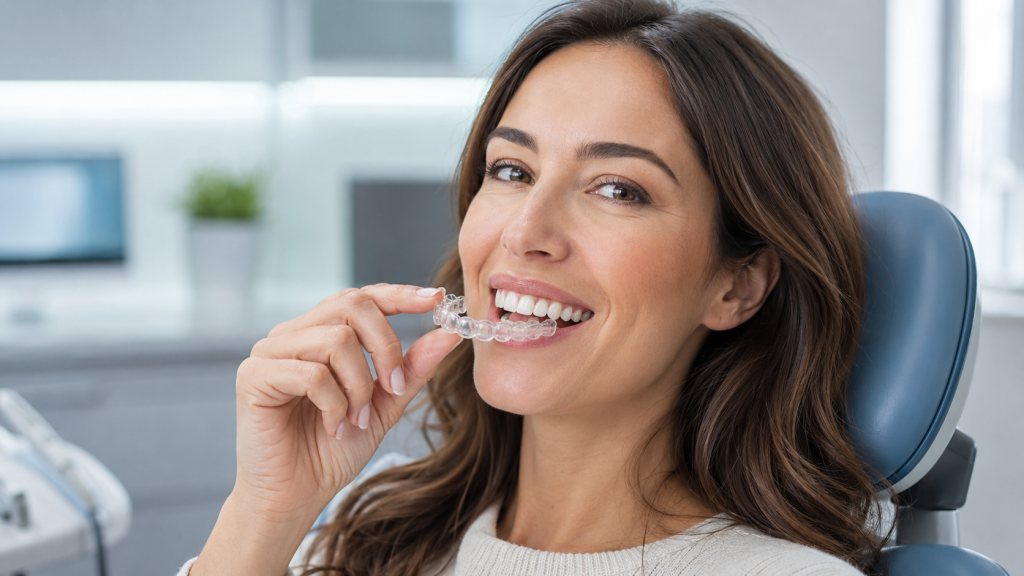
Treatment planning is usually carried out using digital measurements and intraoral scans. This allows the current condition of the teeth to be evaluated and the desired final appearance to be planned in advance.
Each clear aligner applies a certain amount of controlled force to the teeth. The patient wears the aligners for the prescribed period and switches to the next aligner at intervals recommended by the dentist. In this way, the teeth are gradually moved into the desired position.
With these features, Invisalign may be considered a more aesthetic alternative, especially for adults who are uncomfortable with the appearance of braces.
Why Is Invisalign Treatment Preferred in Adults?
When adult patients want to start orthodontic treatment, they often consider factors such as aesthetic concerns, work life, social environments, and daily comfort. At this point, Invisalign clear aligner treatment offers many advantages compared to traditional braces.
- Almost invisible: Clear aligners are not easily noticeable from the outside. This allows patients to continue their social and professional lives more comfortably during the treatment process.
- Removable design: Invisalign aligners can be removed while eating, brushing, and flossing. This provides significant ease of use in daily life.
- Easier to maintain oral hygiene: With traditional braces, cleaning around brackets and wires can be more difficult. Since the aligners can be removed during Invisalign treatment, teeth can be brushed and flossed normally.
- Fewer food restrictions: Since the aligners are removed during meals, they offer more flexibility regarding hard or sticky foods that need to be avoided with traditional braces.
- No metal wires or brackets: Since there are no metal parts inside the mouth, the risk of irritation on the inner surfaces of the cheeks and lips may be lower.
- Digital planning advantage: The treatment process can be planned digitally, and the gradual movement of the teeth can be evaluated in advance.
- Compatible with daily life: Invisalign is a comfortable treatment option that helps reduce aesthetic concerns during meetings, special occasions, presentations, and social settings.
What Are the Differences Between Invisalign and Braces?
Invisalign and traditional braces share the same main goal: to move the teeth into a straighter, healthier, and more aesthetic position. However, there are important differences between the two methods in terms of use, appearance, and daily comfort.
- In terms of appearance: Since braces include metal brackets and wires, they are more noticeable from the outside. Invisalign aligners, on the other hand, are much less noticeable thanks to their transparent structure.
- In terms of use: Braces are fixed and cannot be removed by the patient during treatment. Invisalign aligners, however, can be removed while eating, during oral care, and when necessary.
- In terms of eating: In traditional braces treatment, it may be necessary to avoid certain hard, sticky foods or foods that could put pressure on the wires. In Invisalign treatment, since the aligners are removed during meals, eating may be more comfortable.
- In terms of oral care: In braces treatment, cleaning around the brackets requires more care. With Invisalign, brushing and flossing are easier because the aligners are removable.
- In terms of comfort: Since Invisalign aligners do not contain metal parts, complaints such as poking, friction, or irritation on the inner surfaces of the cheeks and lips may be less common.
- In terms of treatment suitability: Invisalign may be preferred for many mild to moderate orthodontic problems. However, in cases of advanced jaw discrepancies, severe bite problems, or more complex cases, traditional braces may be more suitable.
Therefore, the answer to whether Invisalign or braces are more suitable should be determined by an orthodontist according to the patient’s tooth structure, bite relationship, and treatment needs.
Which Dental Problems Can Invisalign Be Used For?
Invisalign treatment can be used to correct many orthodontic problems. However, suitability for treatment must be evaluated through an examination by a specialist dentist.
- Dental crowding: Invisalign can be used in cases where the teeth overlap, are irregularly aligned, or there is not enough space in the mouth.
- Gapped teeth: Spaces between the teeth can affect aesthetic appearance. In suitable cases, Invisalign can help close these gaps.
- Front tooth alignment problems: Clear aligner treatment can be an effective option for irregularities in the front teeth that affect smile aesthetics.
- Mild to moderate bite problems: Certain irregularities in the bite relationship between the upper and lower teeth can be corrected with Invisalign.
- Relapse after orthodontic treatment: Invisalign may be preferred in patients who have previously had braces but experienced tooth shifting again over time.
Is Invisalign Suitable for Every Adult?
Invisalign treatment may be suitable for many adult patients, but it is not the ideal solution for every case. Suitability for treatment is evaluated according to the current position of the teeth, jaw structure, bite relationship, gum health, and the patient’s compliance with aligner use.
Patient compliance is very important in this treatment. If the aligners are not worn for a sufficient amount of time during the day, tooth movement may slow down and the treatment period may become longer. Therefore, Invisalign may provide more successful results for patients who can wear their aligners regularly and follow the dentist’s recommendations.
How Is Invisalign Treatment Performed?
In Invisalign treatment, the teeth, jaw structure, and bite relationship are evaluated in detail at the first stage. If necessary, X-rays, intraoral photographs, and digital measurements are taken.
As a result of digital scanning and analysis, the patient’s current tooth alignment is examined. Then, how the teeth will move throughout the treatment and what position they are expected to reach at the end of treatment are planned.
Based on this planning, custom-made Invisalign aligners are prepared for the patient. The patient uses the aligners in the order recommended by the dentist. Each aligner applies controlled force to the teeth, gradually moving them into the desired position.
Regular check-ups are carried out during the treatment process. During these check-ups, tooth movement is monitored, the fit of the aligners is evaluated, and it is checked whether the treatment is progressing as planned.
How Many Hours a Day Should Invisalign Aligners Be Worn?
For Invisalign treatment to be successful, the aligners must be used regularly. In general, clear aligners are recommended to be worn for 20 to 22 hours a day.
The aligners should only be removed while eating, brushing, flossing, and when consuming beverages other than water. Not wearing the aligners for long periods during the day may prevent the teeth from moving as planned.
Therefore, regular aligner use is one of the most important factors directly affecting the success of Invisalign treatment.
What Should Be Considered When Using Invisalign?
When using Invisalign, attention should be paid to the cleanliness of both the aligners and the teeth. The aligners must be removed while eating and should not be placed back in the mouth before the teeth are brushed.
The main points to consider during the treatment process are as follows:
- The aligners should be removed before meals.
- The aligners should not be worn again before brushing the teeth.
- Hot and colored drinks should not be consumed while wearing the aligners.
- The aligners should be cleaned regularly.
- When not in use, they should always be stored in their protective case.
- Dentist check-ups should not be missed.
How Long Does Invisalign Treatment Take?
The duration of Invisalign treatment may vary depending on the severity of the dental misalignment, the treatment plan, the patient’s age, and how regularly the aligners are worn.
In cases of mild crowding or minor alignment problems, the treatment period may be shorter. For more comprehensive orthodontic problems, the process may take longer. On average, Invisalign treatment can be completed within 6 to 18 months in most adult patients.
However, this duration is not the same for every patient. The exact treatment time is determined after a detailed examination and digital planning.

Frequently Asked Questions
You can review the frequently asked questions from our patients and contact us for any other questions you may have.
It is generally not painful; however, when switching to new aligners, it is normal to feel mild and temporary pressure on the teeth during the first few days.
If the retainers or fixed wires recommended by your dentist are not used regularly after treatment, there is a risk that the teeth may gradually shift back to their original position.
Prices are determined individually according to the complexity of your case and the number of aligners required. Therefore, the exact cost can only be clarified after the initial examination.
During the first few days, it is normal and temporary to experience slight lisping as the tongue adapts to the aligners. You will adapt within a very short time and return to speaking completely normally.