What Is Sinus Lifting and In Which Cases Is It Performed?
Implant surgery, one of the most reliable and long-lasting methods for treating missing teeth, requires sufficient jawbone volume to achieve a successful outcome. However, especially in cases of tooth loss in the posterior region of the upper jaw, placing implants may not always be directly possible due to bone resorption and the downward expansion of anatomical cavities.
At this point, sinus lifting, also known as sinus floor elevation, one of the most important procedures in modern oral and maxillofacial surgery, comes into play.
So, what exactly is sinus floor elevation, a procedure that paves the way for implant treatment and supports long-term gum and bone health, and who is it suitable for?
Free Information Form
Get Detailed Information!
What Is Sinus Lifting?
The anatomical air-filled spaces located in the skull, just above the right and left posterior teeth of the upper jaw, are called the maxillary sinuses. These cavities have important functions, such as supporting voice resonance and warming the air we breathe.
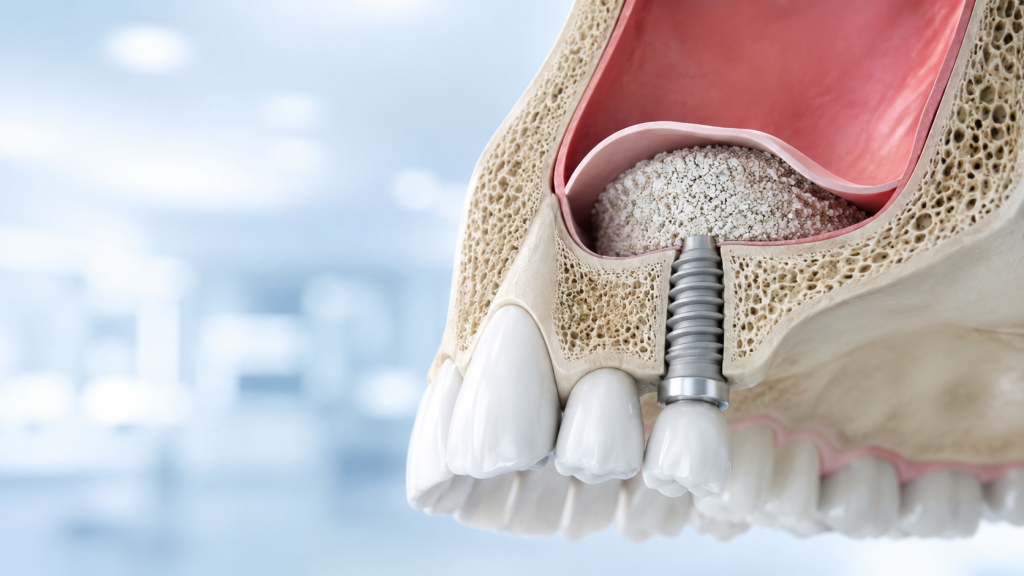
When the teeth in the posterior region of the upper jaw are extracted or lost, the bone tissue in that area begins to resorb over time, and the sinus cavities may expand downward. Sinus lifting is a procedure in which the descended sinus membrane is carefully elevated, and bone graft material is placed into the created space to support new bone formation.
In this way, bone tissue with sufficient thickness and strength is obtained, allowing titanium implants to be placed safely.
Sinus Lifting Methods Before Implant Treatment: Open and Closed Techniques
Depending on the patient’s existing bone volume and the planned implant placement, the oral and maxillofacial surgeon or specialist dentist may choose one of two different sinus lifting techniques. Regardless of the method used, the procedure is generally performed under local anesthesia, in a completely painless and comfortable manner for the patient:
Open Sinus Lifting
This is a classic surgical approach preferred in cases where bone height is below 4–5 millimeters, meaning that significant bone resorption has occurred. During the procedure, a small window is created in the gum tissue to directly access the sinus membrane.
This thin membrane is gently elevated using special surgical instruments, and bone graft material is placed into the created space before the area is closed. With this method, it is usually necessary to wait for the added bone graft material to integrate with the patient’s own bone and harden before the implant can be placed.
Closed Sinus Lifting
This is a more minimally invasive technique used in cases where the existing bone height is more than 4–5 millimeters and relatively less bone augmentation is required. In this method, a separate window is not created in the gum tissue; instead, the sinus floor is accessed directly through the implant socket, also known as the cavity, using special instruments, and the membrane is gently pushed upward.
The greatest advantage of the closed technique is that it allows the required bone graft material to be added and the implant placement to be performed together in the same session.
When Can an Implant Be Placed After Sinus Lifting?
This process varies depending on the patient’s existing bone condition and the surgical technique used.
- Simultaneous Implant Placement: In patients who undergo closed sinus lifting, or in those who have open sinus lifting but still have enough existing bone to stabilize the implant, generally 4 mm or more, bone graft placement and implant placement can be performed in the same session.
- Staged Implant Placement: In cases where the existing jawbone is too thin to support the implant, usually 1–3 mm, bone graft material is first placed through open sinus lifting. An average waiting period of 4 to 6 months is required for the added graft to integrate with the patient’s own bone and harden. At the end of this period, implant surgery can be performed safely.
Things to Consider During the Healing Process
The success of a sinus lifting procedure depends not only on the surgical operation itself, but also on the post-operative instructions followed by the patient. To avoid complications during the healing period, the following points should be carefully observed:
- A cold compress, such as an ice pack, should be applied intermittently to the area during the first 24 hours after the operation.
- To prevent pressure on the sinus membrane, forceful nose blowing should be avoided for the first few weeks, and the mouth should be kept open while sneezing.
- The antibiotics, painkillers, and special mouth rinses prescribed by the dentist should be used regularly and without interruption.
- Drinking liquids through a straw is not recommended during the first few days, as it may increase intraoral pressure.
- Since smoking can delay wound healing, it should be completely avoided or reduced to a minimum during the post-operative recovery period.